
OSS Data Tools Landscape
A landscape of open-source solutions for building a composable data platform: an inventory by function, a classification by data flow, licenses, and an interactive report.
Open the interactive report — search, filters (category, section, license, criteria) and sorting (stars, dates), with top/flop and recent/stale cues. Hosted on GitHub Pages, and also works when opened directly.
Navigation
Catalogues — open-source tools inventoried by function:
- Ingestion & Transport — replication, event/stream, log collection, change data capture (CDC)
- Storage — file formats, object storage, table/metadata layers, vector stores
- Query & Processing — query engines, stream & batch, dataframes, OLAP, time-series
- Analysis & Output — viz frameworks, BI, dashboards, web analytics
- Platform Management — orchestration, data quality, governance, automation, green IT
Cross-cutting analyses — the same tools, seen differently:
- Classification by data flow — streaming / micro-batching / batching
- Flow × Function matrix — each tool mapped to its function and flow
- Visualisations — diagrams (heatmaps, pipelines, decision trees)
Resources:
- Interactive report — search, filter and sort every tool (table view, top/flop, recent/stale)
- Licenses — license families, limits and possibilities
- Profile guides — recommended stacks by company size
Project goals
- Identify the open-source solutions available on the market to build a composable data platform (note: this list may not be exhaustive, given the sheer number of solutions).
- Demonstrate how they work through a simple example implementation: github.com/olexya/data-games-viz.
Market study
Navigating the open-source data landscape
In today’s data-driven world, a myriad of open-source solutions are available to process, analyze and manage data. This abundance offers flexibility and power, but can also be overwhelming for organizations trying to pick the right tools for their needs.
The challenge of choice
The open-source community has developed numerous solutions covering the whole data chain (ingestion, storage, query & processing, analysis, platform management).
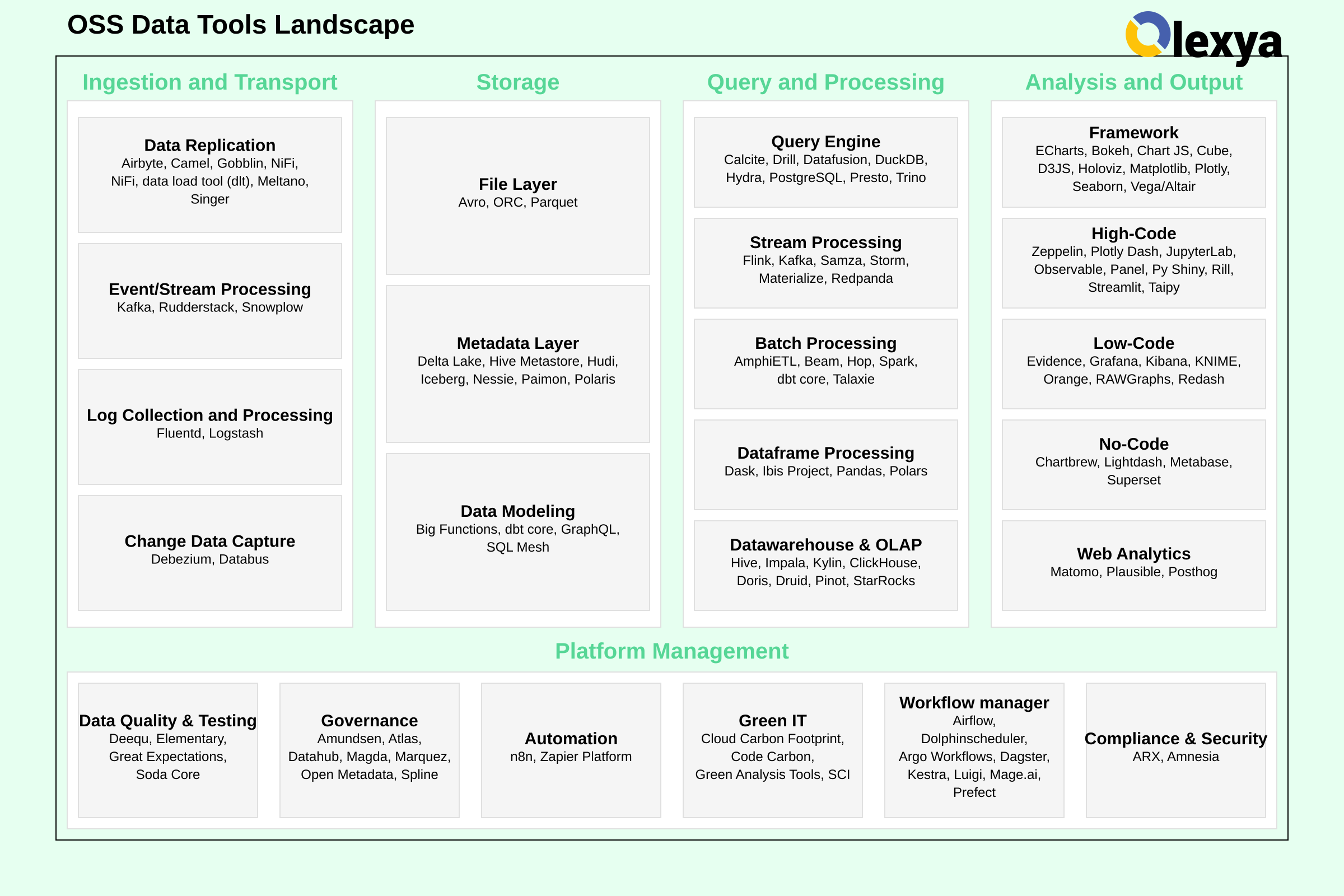
While this diversity is a testament to the field’s innovation, it makes decision-making complex and time-consuming for teams building or evolving their data infrastructure.
Our approach: tailored filters for informed decisions
To help with the choice, we propose a set of filters that take into account factors such as:
- Company size and scale of data operations
- Industry-specific requirements and regulations
- Existing technology stack and integration needs
- Performance and scalability needs
- Level of in-house expertise and resources
- Long-term maintainability and community support
By applying these filters, the vast catalogue is narrowed down to a manageable selection of high-value tools for each use case.
Benefits
- Time-saving: less time spent researching and evaluating unsuitable options.
- Tailored recommendations: aligned with the context and goals.
- Risk mitigation: avoid tools that scale or integrate poorly.
- Informed decisions: a structured approach to comparison and selection.
A working prototype
An application to explore Steam statistics.
It uses Kestra, dbt, Evidence and PostgreSQL.
Get the project: github.com/olexya/data-games-viz